When computer keyboards and word-processing software transformed writing, RSI referred to strain injuries from engaging this new technology. Now it abbreviates recursive self-improvement, a critical self-building acceleration point at which AI trains itself. Doomsayers see RSI as some cataclysm from which there is no return – technology beyond human control, indifferent to the damage it causes in pursuing its goals. Enthusiasts downplay dystopia, instead welcoming RSI as technology fulfilling its promise, a tool of unimaginable productivity, scientific discovery, and more. What does this duality mean for future human/tech engagement, for the transformation project, and whether human choice will remain crucial for purposing technology?
With transformation as the analytical tool, and human/social betterment as its purpose, I will challenge the harm/benefit paradox in terms of human capacities to control the transformation of technology. Heidegger’s vision of technology not as a collection of neutral tools or human inventions, but as a fundamental way of revealing truth, and Polanyi’s take on transformation as a shift from social embeddedness to a tech-managed self-regulating market society form useful theoretical pathways.
To bring this exercise back to relevant transformation research locations and accepting the capacity to make choices as within the essence of human betterment, transforming technology or being transformed by technology are core concerns when addressing the RSI paradox. Technological truth as positive social transformation cannot primarily be left in the hands of creators uncertain when and how it can be effectively controlled. Alternative governance imagining pre and post RSI are offered from my research on disempowering digital dependencies when investigating how AI-assisted decision-making is impacting human capacity to exercise discretion, and thereby be considered intentional and responsible (or not) for the tech transformation. These issues are important variables in critiquing the industry’s argument that governance via human oversight is sufficient.
About the speaker
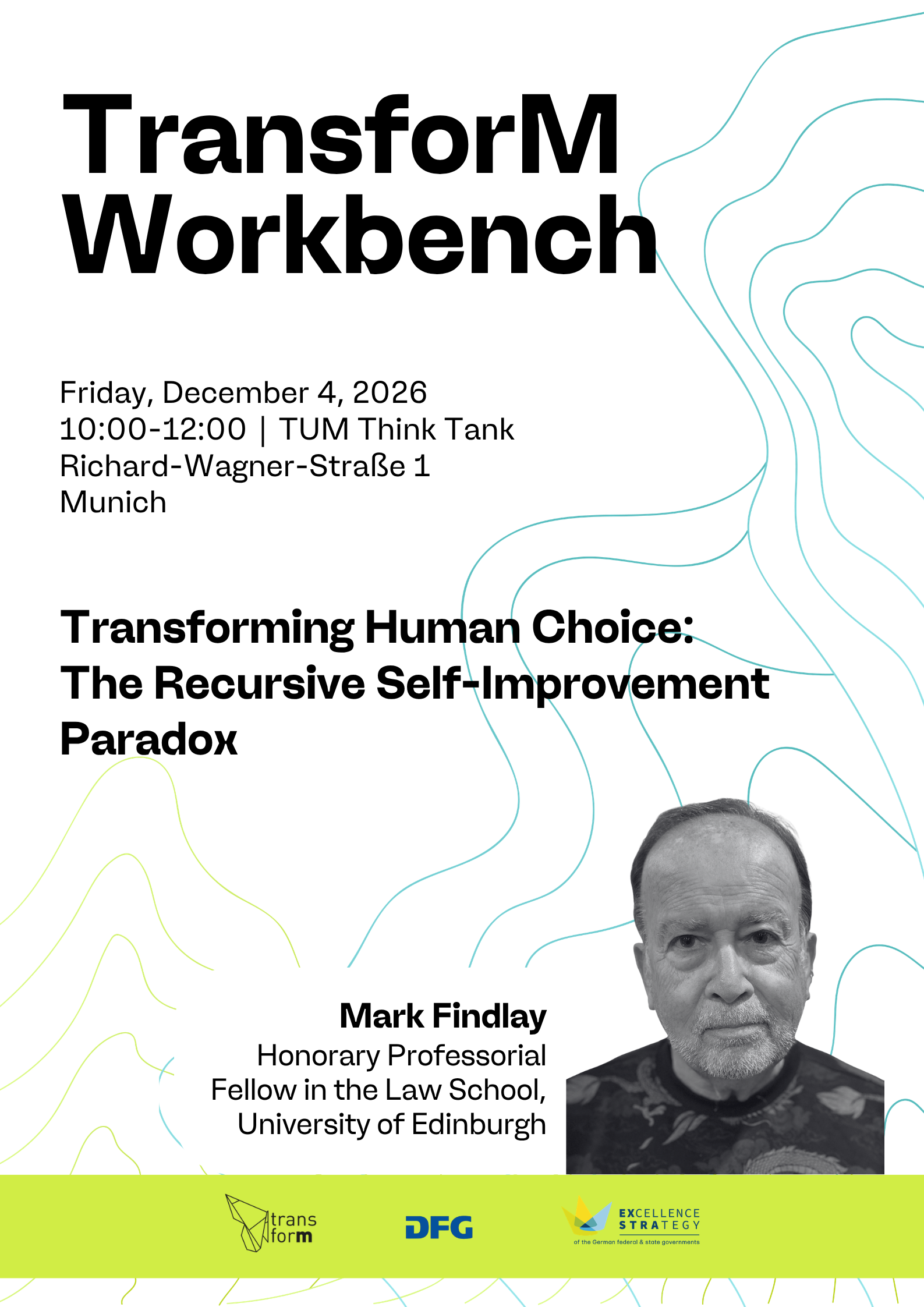
Mark Findlay is an Honorary Professorial Fellow in the Law School, University of Edinburgh. He also enjoys a Visiting Global Professorship, TUM School of Social Sciences and Technology, and is a Distinguished Fellow at the British Institute of International and Comparative Law. He teaches at City University of Hong Kong, and at TUM.
For over a decade Mark was a Professor in the Law School, Singapore Management University, and for several years the Director of their Centre for AI and Data Governance. Prior to that time, he was a Professor in the Law School, University of Sydney for 25 years and the Director of its Institute of Criminology. He has published over 30 books at the intersection of law, technology and governance.
About the event
This is an in-person event open to researchers, students and faculty members from TransforM’s partner institutions.
Register for the event here by 1 December.
Please note that the Workbench will be limited to 25 participants. Everyone who has secured a spot will receive a confirmation by email.